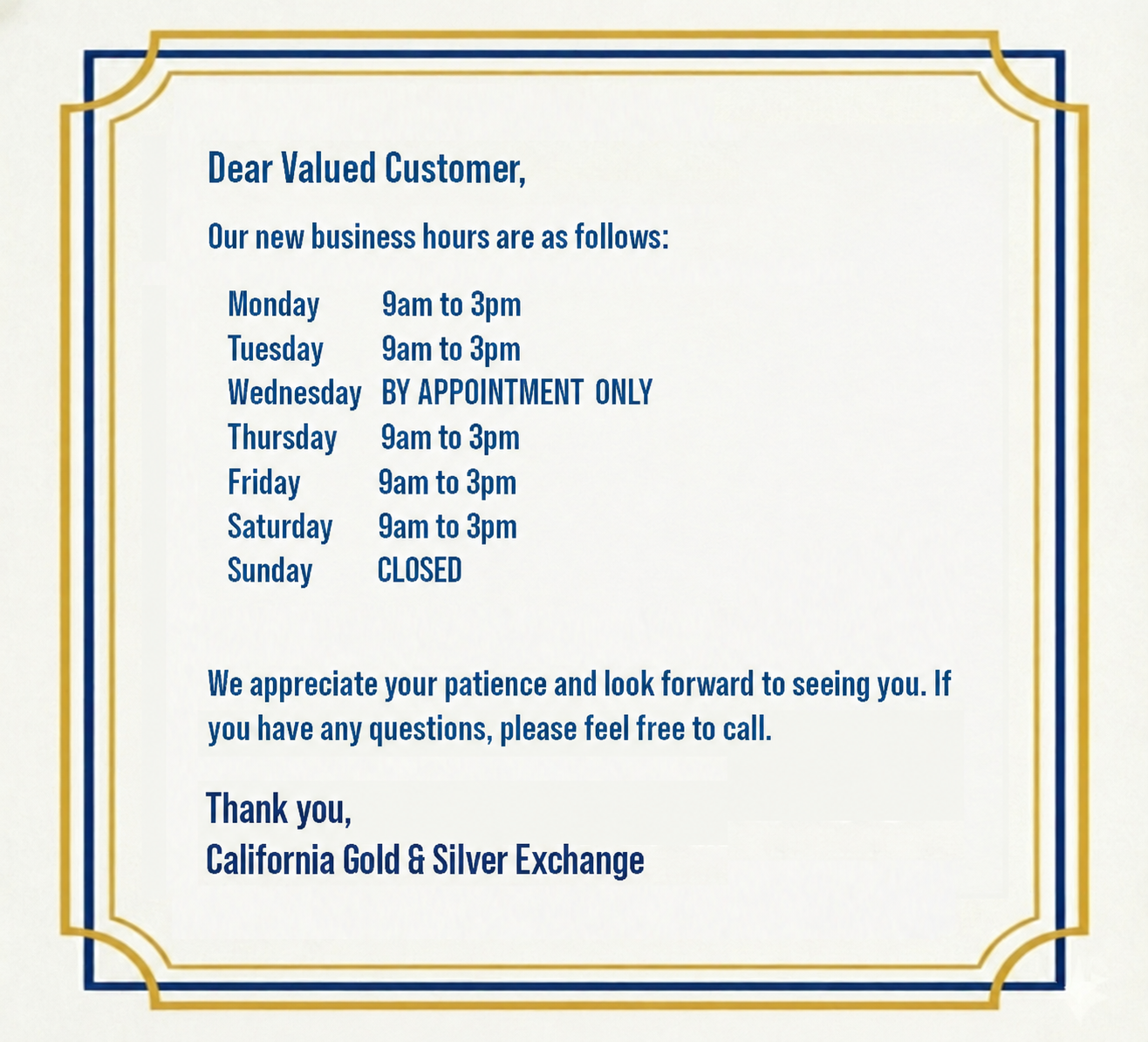
We have received your message. If you indicated that you would like to make an appointment, we will reach out to you shortly.
When you sell gold to us, we will explain every step of the process to help you understand how selling gold works. With your XRF Precious metals Analyzer, we can test your gold to know exactly what purity your gold contains. This helps us assess your gold to give you the most when you sell.
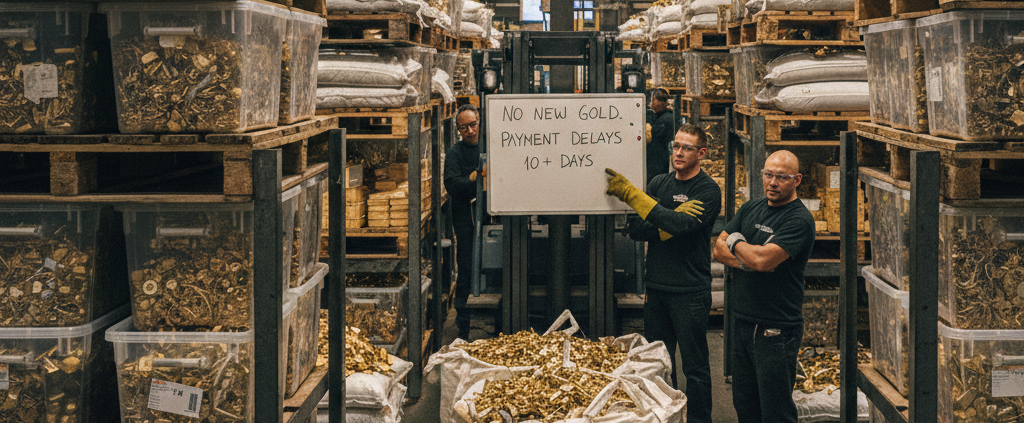
If you’ve tried to sell gold recently, you may have encountered something unexpected: a “waitlist” or a “strategic pause” from dealers and refineries. With gold prices hitting historic milestones in early 2026—surpassing $5,400 per ounce—the market is moving at a velocity we haven’t seen in decades.
At California Gold & Silver Exchange, we believe in transparency. If you’ve heard rumors of “refinery bankruptcies” or “market crashes,” it’s time to set the record straight. The industry isn’t running out of money; it’s running out of room.
The 2026 “Bottleneck”: Why Refineries are Pausing
The current situation is a classic case of a supply chain bottleneck. Record-breaking prices have triggered a massive wave of “street gold”—jewelry, coins, and scrap—flooding into the market.
1. High Volume vs. Processing Capacity
Refineries are currently operating at 100% capacity. When gold prices spiked, the volume of scrap material tripled overnight. Refineries are not just “melting” gold; they must chemically purify it to meet stringent .9999 standards. This process takes time, and there is a physical limit to how much metal a facility can process in 24 hours.
2. The “Cash Flow” Crunch
It sounds counterintuitive: how can a gold refinery have a “cash” problem?
-
Capital Requirements: When gold was $2,000/oz, a refiner needed $2 million to buy 1,000 ounces. At $5,500/oz, that same 1,000 ounces requires $5.5 million in working capital.
-
Credit Lines: Many refineries rely on bank credit lines to pay dealers instantly. With prices rising so fast, many have hit their credit limits, forcing them to pause outgoing payments while they wait for their refined bullion to sell on the global market.
3. Priority Shifting
To manage the backlog, many major refiners (such as Metalor and Elemetal) have temporarily stopped accepting “mixed” or lower-grade shipments. They are prioritizing high-volume, high-purity material to clear the floor as quickly as possible.
What This Means for You (The Seller)
If you are looking to cash in on today’s record prices, the refinery backlog creates a few “ripples” at the local level:
-
Delayed Payouts: Some small-scale shops that usually offer “instant cash” may now require a few days to process your transaction because they are waiting on their own funds from the refinery.
-
Selective Buying: You may find shops refusing to buy silver or lower-purity gold (like 10k jewelry) temporarily, as these take longer to refine and offer lower margins during a liquidity squeeze.
-
The “Spot Price” Gap: Because of the risk and the 7–10 day delay in refining, some dealers are widening their “spread” (the difference between the market price and what they pay you) to protect against price drops while the metal sits in a backlog.
Important Note: This is a liquidity issue, not a solvency issue. The refineries have the gold; they just need the time to process and convert it back into liquid cash.
How to Navigate the Market Right Now
Don’t let the headlines scare you into holding onto your gold if you need the liquidity. Here is how to handle the 2026 backlog:
-
Work with Established Dealers: Larger dealers like California Gold & Silver Exchange often have stronger cash reserves and more direct relationships with refineries, allowing us to navigate these pauses more effectively than small pawn shops.
-
Expect Realistic Timelines: If a dealer asks for a few days to settle a very large transaction, it is a sign of a responsible business managing its cash flow, not a sign of trouble.
-
Purity Matters: High-purity items like 24k coins or bars are still moving the fastest. If you have “scrap” jewelry, be prepared for slightly longer wait times.
The Bottom Line
The gold market is “clogged,” not broken. As refineries catch up with the historic surge of January and February 2026, we expect these pauses to lift and “fast cash” to become readily available again across the board.
Are you looking to sell your gold or silver during this historic rally? Contact California Gold & Silver Exchange today. We provide transparent evaluations and up-to-the-minute market insights to ensure you get the best value, even during a refinery backlog.
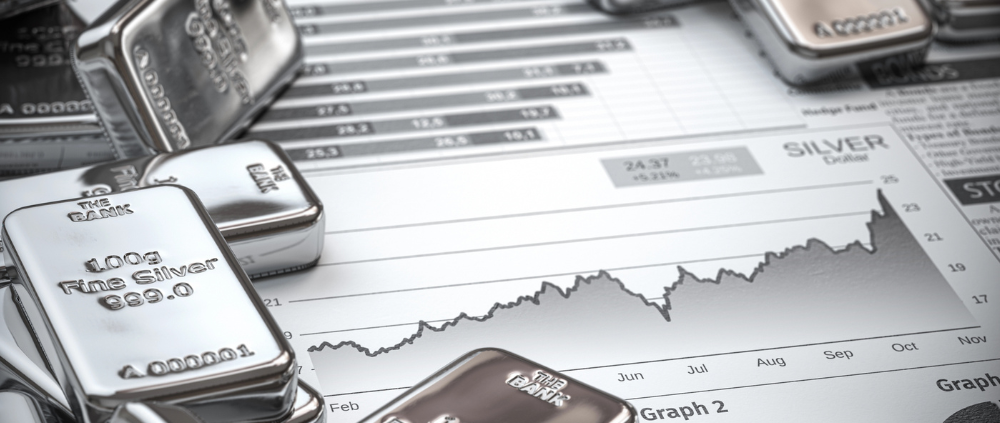
Silver has surged alongside gold, entering 2026 near multi‑decade highs after a powerful rally driven by safe‑haven buying and booming industrial demand. As investors look ahead, many analysts expect silver to remain in a high trading range, with the potential for large swings as economic and policy conditions evolve.
Silver analysts see 2026 as another strong year, with many expecting silver to benefit from both its precious‑metal “safe haven” role and its growing industrial demand in sectors like solar and electronics. Views vary on how high prices can go, but there is broad agreement that volatility will remain high as silver tends to move more sharply than gold during risk‑on and risk‑off swings.
2026 Silver Forecasts From Major Institutions
While silver receives less headline coverage than gold, several large banks and research firms have released silver forecasts that frame expectations for 2026. Precise targets differ by institution, but many concentrate on elevated average prices compared with the pre‑rally years of the early 2020s.
-
Range of institutional targets
A number of bank and brokerage outlooks cluster around a high‑$70s to mid‑$90s per ounce range for silver in 2026, often presented as an average or base‑case scenario rather than a fixed point forecast. Some of these forecasts build in the possibility that silver briefly tests or exceeds recent highs near the low‑$90s if macro and industrial conditions stay favorable. -
Upside and downside scenarios
Bullish scenarios from research desks envision silver breaking into or sustaining levels above $90/oz, especially if gold continues to rise and industrial demand for solar and green technologies remains very strong. More cautious analyses suggest silver could retreat into the $60–$70/oz zone if growth slows, risk appetite improves, or monetary policy turns less supportive than expected.
Across these views, experts emphasize that their numbers are projections, not guarantees, and subject to revision as new data and policy signals arrive.
Why Analysts Are Watching Silver In 2026
Analysts highlight a combination of investment and industrial forces that make silver particularly interesting in 2026. These drivers help explain why many outlooks retain a positive bias even while warning about volatility.
-
Safe‑haven and monetary metal role
Silver tends to benefit from many of the same macro themes as gold, including concerns about inflation, currency debasement, and geopolitical risk. When investors seek hard assets, silver often attracts inflows alongside gold, sometimes outperforming during strong upswings because of its smaller market and higher beta. -
Industrial demand (especially solar)
Silver is a critical input in solar panels, certain types of electronics, and various industrial applications that are expected to grow as the global energy transition continues. Forecasts for rising photovoltaic installations and electrification trends underpin the view that structural industrial demand will remain a key support for silver prices in 2026 and beyond. -
Tight supply conditions
Global mine supply growth has been relatively modest, and some analysts note that silver markets can become tight when investment demand and industrial consumption rise together. In such periods, even small disruptions or demand surprises can trigger sharp price moves, both upward and downward.
Volatility: A Core Part Of The 2026 Silver Story
One point nearly all experts stress is that silver typically trades with higher volatility than gold, especially when markets react to macro news, policy decisions, or geopolitical headlines. That means investors can expect wider and faster price swings even if the overall trend remains constructive.
-
Short‑term corrections from new highs are common, as traders take profits or reposition around major economic data releases or central‑bank meetings.
-
Because of this, many strategists frame 2026 as a year where silver could oscillate within a broad, elevated range, rather than march steadily to a specific target.
For investors, understanding this behavior is crucial when sizing positions and setting expectations for risk and reward.
What 2026 Silver Outlook Means For Investors
For those considering silver as part of a diversified portfolio, the 2026 outlook suggests continued opportunity paired with significant volatility. Many analysts see the combination of safe‑haven appeal and robust industrial demand as supportive of high average prices, but they also warn that timing entries and exits will be challenging.
-
Long‑term investors often focus on gradual accumulation or rebalancing, using pullbacks from spikes as opportunities rather than attempting to chase short‑term rallies.
-
Because forecasts span a wide range—from scenarios that keep silver near recent highs to paths that bring it back toward lower levels—experts recommend aligning any silver exposure with personal risk tolerance, time horizon, and broader financial goals.
For buyers and sellers in California, working with a trusted local precious‑metals dealer such as California Gold & Silver Exchange can help translate global silver forecasts into practical decisions about when and how to add or reduce silver holdings in 2026.

Gold entered 2026 near record highs after a powerful rally in 2025, and many major banks still expect prices to remain elevated this year. While forecasts vary, a number of well‑known institutions now see gold trading mostly in the $4,000–$5,000 per ounce range, with potential spikes above that in more bullish scenarios.
2026 Forecasts From Major Banks
Research teams at global banks have published updated outlooks that provide a useful reference range for 2026 gold prices. The exact targets differ, but the shared message is that gold is likely to stay high compared with pre‑rally levels.
-
Goldman Sachs – around $4,900/oz by late 2026
Reuters‑linked coverage and bank commentary indicate that Goldman Sachs now expects gold to be near $4,900 per ounce by December 2026 in its base case, supported by strong central‑bank purchases and continued investor diversification into gold. -
J.P. Morgan – just above $5,000/oz in Q4 2026
J.P. Morgan’s commodity strategists, as cited in multiple news outlets, see gold averaging a little over $5,000 per ounce in the fourth quarter of 2026, framing gold as a high‑conviction way to position for anticipated Federal Reserve rate cuts. -
Bank of America – path to about $5,000/oz
Bank of America research suggests gold could average in the mid‑$4,000s in 2026, with upside toward roughly $5,000 per ounce, driven by large fiscal deficits, rising debt levels and pressure for lower interest rates that keep real yields under downward pressure. -
Morgan Stanley – mid‑$4,000s in 2026
Morgan Stanley analysts are somewhat more conservative, with commentary indicating an expectation for gold around the mid‑$4,000s per ounce by mid‑ to late‑2026, helped by ongoing ETF and central‑bank demand but tempered by the potential for corrections after 2025’s sharp rally. -
HSBC – volatile range with potential move to $5,000/oz
HSBC’s latest note, summarized in financial media, points to a wide 2026 trading band roughly between $3,950 and just over $5,000 per ounce, with a possible spike toward about $5,000 per ounce in the first half of 2026 and an average price in the mid‑$4,000s.
These are estimates, not guarantees, and each bank stresses that changing economic data or policy decisions could shift their targets up or down.
How Analysts See The 2026 Range
Beyond individual bank calls, broader market commentary offers a useful way to frame the likely range for gold in 2026. Many outlooks expect consolidation at high levels, with room for both rallies and sharp pullbacks.
-
Several scenario‑based pieces suggest gold could spend much of 2026 between $4,000 and $4,500 per ounce in a “base case,” with breaks above that zone opening the door to moves closer to $5,000 per ounce during periods of heightened uncertainty.
-
Research from State Street Global Advisors and other institutional managers highlights a bull case in which gold trades closer to $4,500–$5,000, and a bear case where it retreats toward the high $3,000s to low $4,000s if growth and the U.S. dollar recover more strongly than expected.
-
Some independent analyses that aggregate bank and broker forecasts show an overall market expectation for elevated average prices in 2026, even if the exact peak is uncertain.
For investors, the key takeaway is that experts see gold staying structurally strong, but do not assume a smooth or one‑way climb.
Key Factors Driving Gold Prices In 2026
Analysts repeatedly point to a familiar set of fundamental drivers behind their 2026 forecasts. Understanding these forces can help explain why so many projections cluster in the higher price ranges.
-
Central‑bank demand
Central banks, particularly in emerging markets, have been steadily increasing their gold reserves in recent years to diversify away from the U.S. dollar and strengthen financial stability. Many outlooks expect continued net central‑bank buying through 2026, which provides a structural floor under prices. -
Interest rates and real yields
Several banks base their bullish views on the expectation that the Federal Reserve and other central banks will cut interest rates or keep them relatively low, which typically pushes down real yields and improves the appeal of non‑yielding assets like gold. If rate cuts are larger or faster than expected, upside risk for gold increases; if policy turns more hawkish, it could limit further gains. -
Inflation and currency concerns
Persistent inflation, high government debt and concern about long‑term currency debasement remain central pillars of the positive gold thesis. Analysts note that investors continue to see gold as a long‑term hedge against purchasing‑power erosion and currency volatility, which supports demand even when short‑term data fluctuate. -
Geopolitics and safe‑haven flows
Ongoing geopolitical tensions, including conflicts and major‑power rivalries, are another reason many strategists expect robust safe‑haven flows into gold in 2026. Episodes of market stress or headline risk can drive price spikes even within a broader consolidation range. -
Market positioning and volatility
Commentaries also warn that after large gains in 2025, crowded positioning can lead to sharp corrections, especially if traders take profits or macro data briefly support risk assets. That is why many 2026 outlooks emphasize a volatile but upward‑biased environment rather than a straight line to the highest targets.
What This Means For Gold Investors In 2026
For investors considering physical gold or other forms of exposure, the expert consensus points toward continued strength with meaningful volatility in 2026. High‑profile banks broadly expect prices to remain elevated compared with past years, but they also caution that pullbacks are likely and forecasts can change.
-
Many strategists suggest that gradual accumulation on dips may be more prudent than chasing short‑term spikes, especially for long‑term holders using gold as an inflation hedge or diversification tool.
-
Because projections span a range—from scenarios near the high‑$3,000s to more bullish paths toward $5,000 per ounce—experts recommend aligning any gold allocation with personal risk tolerance, time horizon, and overall portfolio mix rather than trying to pick an exact top.
For Californians looking to translate these global forecasts into real‑world decisions about buying or selling physical gold, working with a trusted local dealer like California Gold & Silver Exchange can help turn big‑picture insights into a tailored strategy that fits individual goals and comfort levels.