Gold buyers pay less than the spot price because dealers need to make a profit. Weight, purity and that margin turn the spot price into your real payout.
If you have looked up the gold price and then received an offer that sat a little lower, nothing is necessarily wrong. This post explains what the spot price means, how weight, purity and a buyer’s margin turn it into a real payout, and what an honest buyer shows you. Whether you are sorting through a parent’s jewelry in Southern California or adding gold and silver to your savings, this math helps you make informed decisions.
What Does the Spot Price Actually Measure?
The spot price of gold is the current market price at which gold can be bought or sold for immediate delivery. When someone says “gold is up today” or the news quotes the gold price, this is usually the number they mean. Silver and platinum have their own spot prices that work the same way.
Dealers use it as the basis for setting their buying and selling prices for bullion. Think of it as a benchmark tied to wholesale trading, not a price any retail customer is guaranteed. The figure you see online and the figure on a buyer’s quote will rarely match exactly, and the next section explains why.
Spot is quoted per troy ounce, the standard unit for pricing precious metals, and one troy ounce equals 31.1034768 grams. A kitchen or jeweler’s scale reads in grams, so converting between the two is the first step in any honest calculation.
Why Does a Dealer Buy Below Spot and Sell Above It?
When buying gold, dealers typically offer slightly below the spot price so they can make a profit. On the selling side, the price a customer pays for a gold coin is typically calculated by adding a premium to the current spot price. One number sits below spot, the other above it, and the gap between them is the spread.
That margin has real work to cover: testing what you bring in, refining it into pure metal, and the risk of reselling it later. A gap is normal and is not a sign that anyone is cheating you. If you are a saver, the premium on a coin is the same spread seen from the buying side.
From Spot to Your Payout: Weight, Purity, Then Margin
Every fair payout follows the same order.
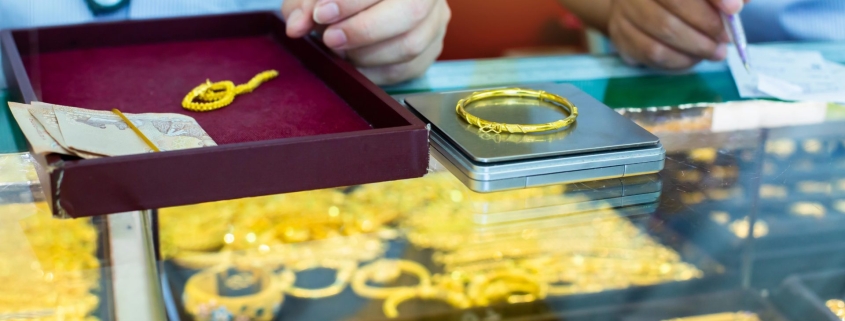
Weight comes first. Your items go on a scale, and that number is the foundation for everything else. Purity comes second, measured in karats for jewelry. A piece stamped 14K is not pure gold, so only part of its weight counts as gold. The buyer’s margin comes last.
Melt value is worked out from weight in troy ounces, purity and the current spot price. It is what the metal itself is worth before the margin comes off. With inherited jewelry, stones, clasps and other non-gold parts add weight but no gold, which is why the scale and the purity test come before any number is spoken.
A Worked Example: 10 Grams of 14K Gold
A melt value page uses 10 grams of 14K gold as its example, so we will follow it.
- Convert grams to troy ounces. 10 ÷ 31.1034768 is about 0.3215 troy ounces.
- Apply purity. The page uses 0.585 as the purity figure for 14K. 0.3215 × 0.585 is about 0.188 troy ounces of pure gold.
- Multiply by spot. Take 0.188 and multiply it by the spot price per troy ounce. The result is the melt value.
Whatever spot happens to be, those 10 grams of 14K hold about 0.188 troy ounces of gold, no more. Spot moves during the day, so the final dollar figure moves with it. The buyer’s margin then comes off the melt value, which is why an offer lands a little below it. A gram of 14K is worth far less than a gram of pure gold, and this is the reason.
The worked example at a glance
| Step | Figure |
|---|---|
| Starting weight of the piece | 10 grams |
| Grams in one troy ounce | 31.1034768 grams |
| Weight in troy ounces | about 0.3215 troy ounces |
| Purity figure used for the karat stamp | 0.585 |
| Pure gold in the piece | about 0.188 troy ounces |
Notice how the starting weight shrinks to a smaller amount of pure gold once it is converted and the purity figure is applied.
What an Honest Buyer Shows You
You can judge any buyer by what happens at the counter. Look for these:
- Your items weighed on a scale where you can see the reading.
- Purity tested, with the result told to you.
- The spot price used for the calculation, named out loud.
- The percentage of that value the offer represents.
At California Gold & Silver Exchange, we believe in being honest and transparent, and we do not use pressure tactics. We are family-owned and rooted in Upland, with 50+ years of combined expertise on our team. We hold certifications including BBB, GIA, NGC and PCGS. We help you make informed decisions, and the decision always stays yours.
Selling locally means no shipping risk and secure transactions, with no package leaving your hands. If you are on the buying side, we can also offer guidance on IRA-approved metals.
Many of our sellers are handling a parent’s or grandparent’s belongings, and we know that is about more than metal. We treat you as part of the family.
Call for Today’s Buy and Sell Prices
Spot changes throughout the day, so a current quote is the only reliable number. Before you call, gather what you are curious about: jewelry with its karat stamps, coins, or bars. Note anything graded by NGC or PCGS. You do not need to sort everything out first, and you do not need to decide anything on the phone.
Call California Gold & Silver Exchange for today’s buy and sell prices. We will walk you through the numbers in plain words, with no pressure and no promise of profits, just a straightforward conversation about what your gold or silver is worth today.